

Fly midway
The beginning of the end.

But when at last
the father finished it, he poised himself,
and lightly floating in the winnowed air
waved his great feathered wings with bird-like ease.
And, likewise he had fashioned for his son
such wings; before they ventured in the air
he said, “My son, I caution you to keep
the middle way, for if your pinions dip
too low the waters may impede your flight;
and if they soar too high the sun may scorch them.
Fly midway. Gaze not at the boundless sky,
far Ursa Major and Bootes next.
Nor on Orion with his flashing brand,
but follow my safe guidance.”
- Metamorphoses, Book 8
And so it began. Four competitions, favourites supposedly in all. Of course a quadruple seemed an absurd dream, but the whispers were steel-edged with the simple truth that Arsenal, at their height, are the best club football team in the world. Since their last bout with Manchester City, they had not faced a single shot on target while losing. Winning everything seemed possible because this team simply never lost to anything but miracles or bizarre chance, and they stayed in every game until the end. Such ruthless competitiveness appeared the perfect weapon for tournament football. It was hard to imagine them ever being beaten across a 90 minute stint with immediate and meaningful stakes. They resisted and adapted and struggled and then they won, over and over, a machine bred for the purpose. They found a way. They found a way.
I suppose there’s a poetic irony to this myth being unravelled by the enemy that had so defined Arsenal’s creation. In any story, great antagonists are manifestations of the idea our protagonist must grapple with to become whole, often by defeating it - but in many of the best cases, integrating it. “All tales […] are a journey into the woods to find the missing part of us, to retrieve it and make us whole,” writes John Yorke in Into the Woods (which, for anyone seeking to write, should be read). “Storytelling is as simple - and complex - as that.” There’s not much for Ripley to learn from the alien in Alien, but she learns things about herself under the friction its danger generates; whereas the Joker forces Bruce Wayne to realise he must stretch his narrow definition of justice to include a little amoral chaos in The Dark Knight. Mikel Arteta’s Arsenal have adapted constantly in response to Manchester City. They became bigger and stronger to close the physical gap, more relentless to narrow the space in point accumulation, impossible to score against to shave down the goal difference. As smarter friends have noted, in many ways Arteta’s project has for a long while seemed to have one objective: defeat City, specifically. He believed the blue juggernaut held the thing he needed to be whole, and ventured into the woods to find it. Yesterday evening, it all fell apart.
Before Sunday’s final, narrative erupted: “Arsenal achieve the impossible,” wrote Jamie Carragher for the Telegraph, “inspiring neutrals to root for Manchester City.” He argued the root cause is mostly stylistic, which I find hard to accept. Fans can blather and bleat about corners and free-flowing football or whatever, but will never wilfully engage with what is, in my opinion, the obvious truth. They would rather City beat Arsenal to the title for the same reason they preferred them to Liverpool all those years: because it’s painless. City operate in an emotional black hole, a void of feeling, a total blanket of apathy that’s antithetical to the things that give football meaning.
I struggle to keep a lid on how I feel about all of this; I’ve deleted hundreds of words from this blog already (edit: now thousands). I must remember I am a Very Serious Journalist, with professional connections and a reputation to uphold. And whatever I say about City will just come across as bitter and spiteful and a pathetic attempt to make myself feel better about losing a final, which, to be clear, it would in part be. For now I’ll merely point you towards the thousands of words I’ve written on the club already, about their ownership’s role in the Darfuri genocide (which has taken on a new element since Guardiola was glazed relentlessly for his bravery in speaking out in support for Palestine, a development which left me so disgusted I could barely talk for a week) and the unmooring and insidious effect sportswashing has on anyone attempting to engage emotionally with football. This has all become so much worse since I last spoke about it; 2026 has felt like a slow descent into total madness. And I suppose that’s why we’ve all attached to a simple, inarguable truth: genocide and cheating is simply less bad than being good at corners.
I think I’ll give up trying to convince others Manchester City should be everyone’s enemy, not just Arsenal’s. If they can get away with all this and emerge with nothing but praise, they can get away with anything. I just hope people enjoy the silence. City have won this round, and none of you need to worry about Arsenal fans being a bit annoying on Twitter. It’s nice, isn’t it? The quiet?
A MOMENT OF YOUR TIME: I have somehow conned* the good people at the British Library, one of my favourite space in London**, to let me speak on a panel at the Football Writing Festival: Arsenal Special. I’ll be appearing alongside Clive Palmer, Ed Fenwick, Max Giles and Boyd Hilton. It’s this Saturday, and the event features icons like Amy Lawrence, Martin Keown and Nick Hornby. I don’t get it, either. Tickets can be bought here.
I am also fundraising for my first half-marathon in April. Everything’s happening at once. Help?
*I was asked.
**I’ve lost my reader pass.
Let’s keep this story about our protagonist. Arsenal were, on Sunday, appalling. In anger I wrote it was the most embarrassing performance I can remember from a senior Arsenal side, which is of course a bit absurd and reactionary, but rooted in the bizarre dislocation I felt between the myth that’s surrounded this team and the things they did on the pitch. Never before has a performance felt so starkly different from Arsenal’s pre-match legend. In Baku a joke of a team tried to save some face, and landed flat on their own. In 2018 a team miles below City’s level went in as underdogs and took a beating. Here, the supposed champions-to-be, a juggernaut built for victory, made a huge song and dance about this being the start of their legend, the beginning of a new era, and then collapsed, whimpering.
It was so bad I’m not sure what to react to. After Kai Havertz went close in the opening minutes Arsenal simply didn’t do anything. Embarrassing, because the fight and desire we’ve spent so much energy convincing ourselves would carry us was totally absent. City had four men stand next to each other in a line and Arsenal reacted like they were trying to solve the Enigma code. Embarrassing, because it proved all the stories about us true: we are all bluster and noise, we are nearly-men, we are just set-pieces and bullying. City couldn’t enter the box at all for thirty minutes but once they did they didn’t stop, and Arsenal looked totally powerless. Embarrassing, because it was proof we’re simply not as good as we think we are.
I don’t particularly blame Kepa Arrizabalaga, who I think is generally a good goalkeeper, because I can’t imagine how difficult it must be to maintain physical and emotional levels while spending 95% of a season on the bench. I think this result was instead largely the culmination of Arsenal’s bizarre season-long slide away from the scalpel and towards the sledgehammer. The team’s falling technical floor has, of course, been largely a product of which playing staff have been available. The side - and the season - looks very, very different with Martin Ødegaard, Kai Havertz, Mikel Merino and Riccardo Calafiori fit all year long. Without them Arteta has continued his pursuit of domination in a different, more direct form, without the total commitment required to totally impose it. Stylistically Arsenal have landed in a weird liminal space, a team who say they want to be the best at everything but are instead simply good at most things. They trot out fast, very direct lineups and play possessive football that goes nowhere; they pack a team with technicians and sit in their own box. Perhaps this is the other side of the coin to having such a deep and varied squad: the style of the team must change dramatically if Eberechi Eze is available but Martin Ødegaard is not. Such variance has made stylistic commitment and continuity difficult, but Arteta hasn’t helped himself. In the absence of Calafiori he could have turned to Myles Lewis-Skelly, for example - who, please remember, played in wins against both Bayern Munich and Atlético Madrid - to approximate the Italian’s chaos and progression, but hasn’t. This half-and-half, milquetoast approach has proven good enough to grind out a host of closely fought wins in a Premier League season where ‘grind’ has become the key word, but is beginning to look like it will come unstuck against the greatest challenges. This all-conquering side has played four games against Liverpool and Manchester City so far this term and won none.
Good sides losing always results in the kind of fatalism I’m engaging in right now, and it’s often a bit silly. This was the first time Arsenal have lost a game by more than a single goal this season. They are still extraordinary, a team packed with quality and talent and boasting one of the greatest defences this era of football has yet witnessed. But I am, quite frankly, terrified. I could accept losing if it was tight, hard-fought, a flurry of deftly traded blows settled by a chance knockout sneaking through a guard. But on Sunday Arsenal were totally outmatched. I have written before about how top sides come to the Emirates and desperately set up to contain what they know could be a bloodbath, but at Wembley that wasn’t true at all. City’s approach could not have been more different to our early-season bout: they looked assured, like they knew exactly how to beat Arsenal and were convinced they could. Arsenal, meanwhile, looked an exhausted, confused side with few ideas and no energy to execute them.
I cared so deeply about this game because it seemed a precursor to what could be a very, very special run: win here, and everything else will fall into place. I am dreading what the opposite outcome might now mean. Arsenal have convinced everyone else they still have a long way to go to become champions and I worry enormously they might have convinced themselves, too. I worry Arteta might have stretched too far, that by building a squad capable of winning everything he might go home with nothing at all; that in he end he might be Icarus, festooned with beautiful wings and flying directly towards the sun.
Now we can only wait. What story Arsenal are writing remains in their hands. Mikel Arteta must find his solutions. He must once again accept the truth his enemy has offered him and learn what he can, because Manchester City are going to define this final moment and whatever denouement may follow. A performance like this at the Etihad would be catastrophic.
In all great stories a truly dramatic fall comes before the triumph. The protagonist must hit rock bottom, having accepted the truth to make them whole, and must question their purpose entirely. In the journey of any great hero they overcome this moment of doubt and rise to triumph still. But not all stories are triumphs, and that’s what makes football so enticing - we won’t know what we’re watching until it’s done.
In Into the Woods, Yorke lays out his roadmap for change in a typical five-act structure. Act four has three stages: doubt, growing reluctance, and regression. No story, triumph or tragedy, ends with act four. The final always follows. Reawakening, re-acceptance, and total mastery.
The Partridge hides
in shaded places by the leafy trees
its nested eggs among the bush's twigs;
nor does it seek to rise in lofty flight,
for it is mindful of its former fall.
- Metamorphoses, Book 8
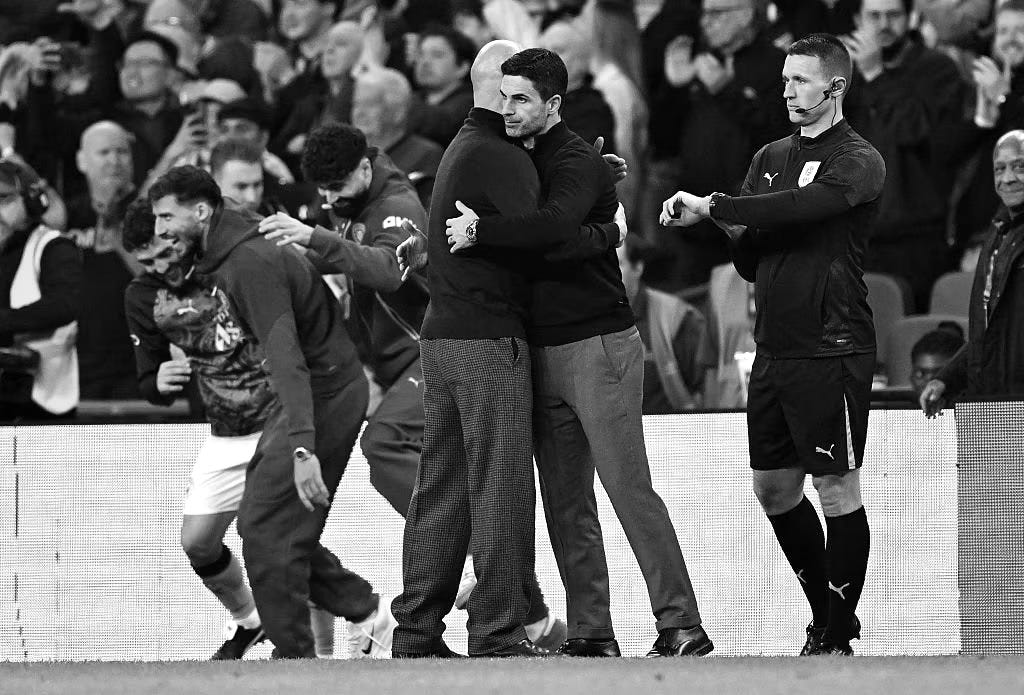
If Arsenal can use this interlull as a platform to reset, recover and rediscover themselves, which leads to the league title, this defeat would just make that even sweeter.
And yes a very serious journalist/writer