

No indecision
You always, always come home.

When Eberechi Eze joined Arsenal, the club made him a one-minute, sixteen-second short film. He was unveiled at Emirates Stadium like a galactico of myth, smiling at the sky as Sampha bellowed the anthem the winger had been bestowed: “Laugh and leave with what you know / But the pain won’t subside at all / Let it all work out.”
We were obsessed, intoxicated, and why not? The story was simple. The hero’s journey, writ large and real for us to watch: rejected by Arsenal, barraged by failure; starting from the bottom, Eze climbed his way back to us. He emerged, beaming, from the red tunnel as if it were ordained. He was home.

Noni Madueke, meanwhile, was given a shorter, muted (but still stylish) announcement video upon his summer move. On YouTube, it has less than one third of Eze’s views, despite existing for a month longer. The comments are largely to the effect of ‘I don’t like it but will back him’ or ‘prove the haters wrong, my guy.’
The film ends with the line: “You always, always, come home to north London.” Madueke was born in Barnet, thirty minutes from Highbury.
I don’t need to tell readers of this newsletter Madueke’s arrival was met with a heady cocktail of reluctant optimism and outright animosity. There were a number of factors at play: Arsenal had given Chelsea a lot of money, again; the shadow of Willian, David Luiz et al still hasn’t faded; Madueke was not Eze, or Rodrygo, or any of the left-sided megastars the club supposedly wanted.
But most powerfully I think there was a conception among many that Madueke was simply not very good. He has always been an unorthodox watch, a tall winger who rarely seems in control of all his limbs at once. His arms and legs fly madly in contortionist shapes as he drives into the box - shapes that make these constant entries seem almost accidental. There have been questions about ‘final product’. He barely played at PSV before Chelsea stuck him on their endless conveyor belt. He’d come through at Tottenham, for God’s sake.
And so while we celebrated the south London boy coming north of the river, threw laurels and anthems his way, we largely ignored the player who had truly come home. Noni Madueke had left north London as a child and returned a man. But we just didn’t care all that much for his story.
In Let it all work out, I argued the message of Sampha’s Indecision had been flattened by social media, and squeezed into the shape we wanted to celebrate: we used it as if it told a tale of inevitability, that it presaged Eze’s glorious return. In reality Indecision is about taking a chance in the face of overwhelming fear: “Your heart pounds with precision / A king dies inside his courts.”
My friend Billy wrote an expectedly thorough breakdown of Noni Madueke upon his arrival at Arsenal. Among the tactical insights, there’s a lot to glean on his character, if you care to look.
“You have to have a little bit of healthy delusion,” Madueke told GQ in June. “When that delusion comes in – we're calling it healthy delusion, but it's probably extreme faith in your ability – I feel like that's when you can really reach new heights,” he said. “You need it as a football player. You need it.”
Calculate indecision, can't cradle fear no more.
Madueke moved from London to Eindhoven at sixteen. In 2018, the wave of English talents going to Europe had barely begun; Jadon Sancho had moved to Germany a year prior; Ruben Loftus-Cheek and Fikayo Tomori were still in England; Jude Bellingham was hardly known, a quiet roll of fifteen-year-old thunder gathering momentum in Birmingham. It’s easy to forget just how few English players ever went to the continent before this new wave. Madueke didn’t flinch. He quickly became fluent in Dutch because “[he] didn't want anyone talking shit about [him] on the field.”
Mind your tongue, inhibition, for once against the wall.
Back to London and stuffed changing rooms, a carousel of coaches, and a new kind of noise. Madueke became Chelsea’s most important attacking player anyway, by dragging his side up the pitch and into the box with a relentless resolve. He simply would not take no for answer. He established himself as one of the most consistently progressive and dangerous wingers in the league, despite whatever weird shapes his limbs made as they moved. Aesthetics are second to results. Naturally, Chelsea sold him.
From the office of wisdom, my answers don't hear their calls.
Back north, to the streets he once walked. A muted homecoming, with nobody to point at all the wrecked walls he’d walked through to get here. All the courts he’d smashed through, the doors he’d opened without thinking. You see, when you jump fences so easily it stops being impressive or even notable; we need pressure, the threat of imminent and terminal failure, to tell a great tale.
It’s early in the game and he has the ball by the right touchline. He is perfectly static, upright; there is no warning of what’s about to come. And what he does is difficult to capture in words with any sort of precision: from a standing start his legs move one way before they change their mind, then again and they whip back the way they first threatened, and it all happens so quickly it’s difficult to follow; and then he’s gone and the ball’s gone with him, somehow, I’m not sure I didn’t see - and then he’s in the box, and riding the byline like a skateboarder grinding a rail. What happened? Run it back. VAR, can we get a replay?
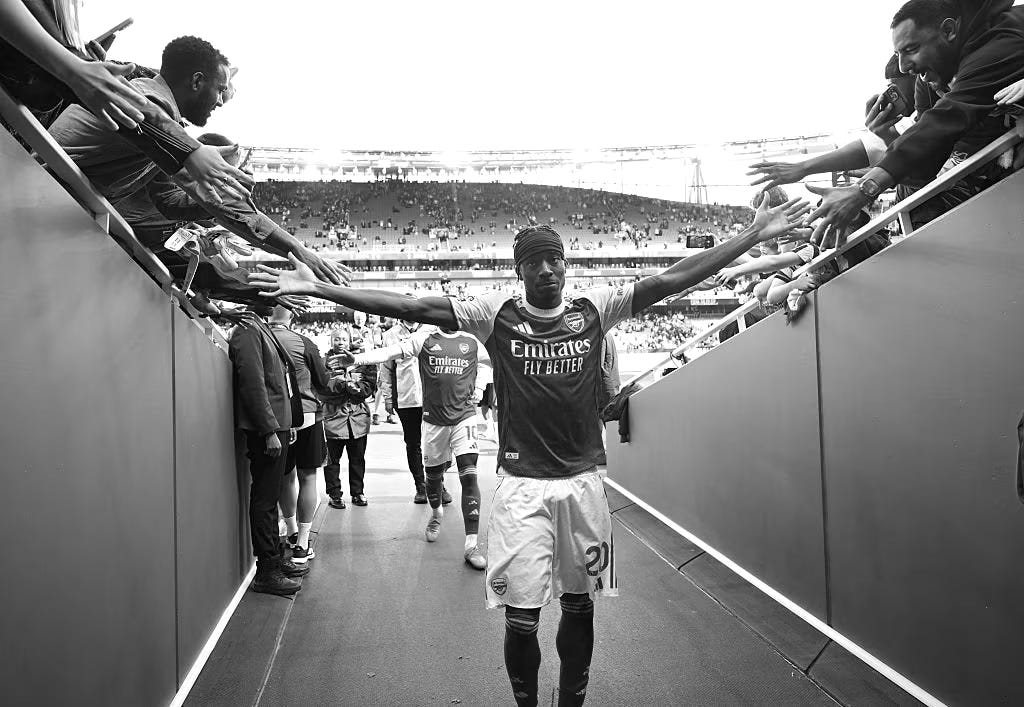
Noni Madueke came home in July but arrived against Nottingham Forest on Saturday. He was a constant terror with the ball; his set piece delivery was perfect; he gave two different full-backs a torrid time. His sense of pace - and by that I mean not just speed but the knowledge of when to subtract it, when to take the tempo down - is alarming: he can stop and start as you blink or just suck all the speed out when languor is most dangerous. Twice he stopped in the box entirely, waiting, and then fed an overlap to generate two of the game’s best chances.
But it was his joy that got me most. As Martin Zubimendi thumped in the opener and then thumped the sky, Madueke thumped it with him. His contagious smile was painted across every goal; he celebrated each like a happy child. And after the game he stood and sheepishly laughed with Eze as Martin Keown posed him questions about his selfishness and answered with that same line: “I think it’s important to keep that self-belief where you can get the ball and just do it yourself,” he said. “As a winger, I feel like you need that.”
And there was the joy again, when asked about the Champions League: his first time, it’s so easy to forget. Another wall in his way, another pile of rubble to walk over.
So we’ve fallen in love with the story of Ebere Eze, of rejection and finality defeated, of letting it all work out: but I wonder if another London boy deserves that story just as much. Noni Madueke has never had that second-act moment of crisis, crucial to a good hero’s journey, because he’s made it all look so easy. Jumping fences, twisting limbs. No indecision, not once, not for a fleeting moment. Has his heart ever pounded with fear? You wouldn’t know it, not by looking - but if it has, he has defeated it.
So: a boy who travelled to chase his dreams and and walked through walls of noise at every turn until the force of his talent brought him here, back home, to the streets he once walked?
Now that’s a story worth telling.
Wow... Nice read! #COYG ♥️
Love this 👏